What Is Pointfighting? Rules, Scoring & Benefits Explained
In this article
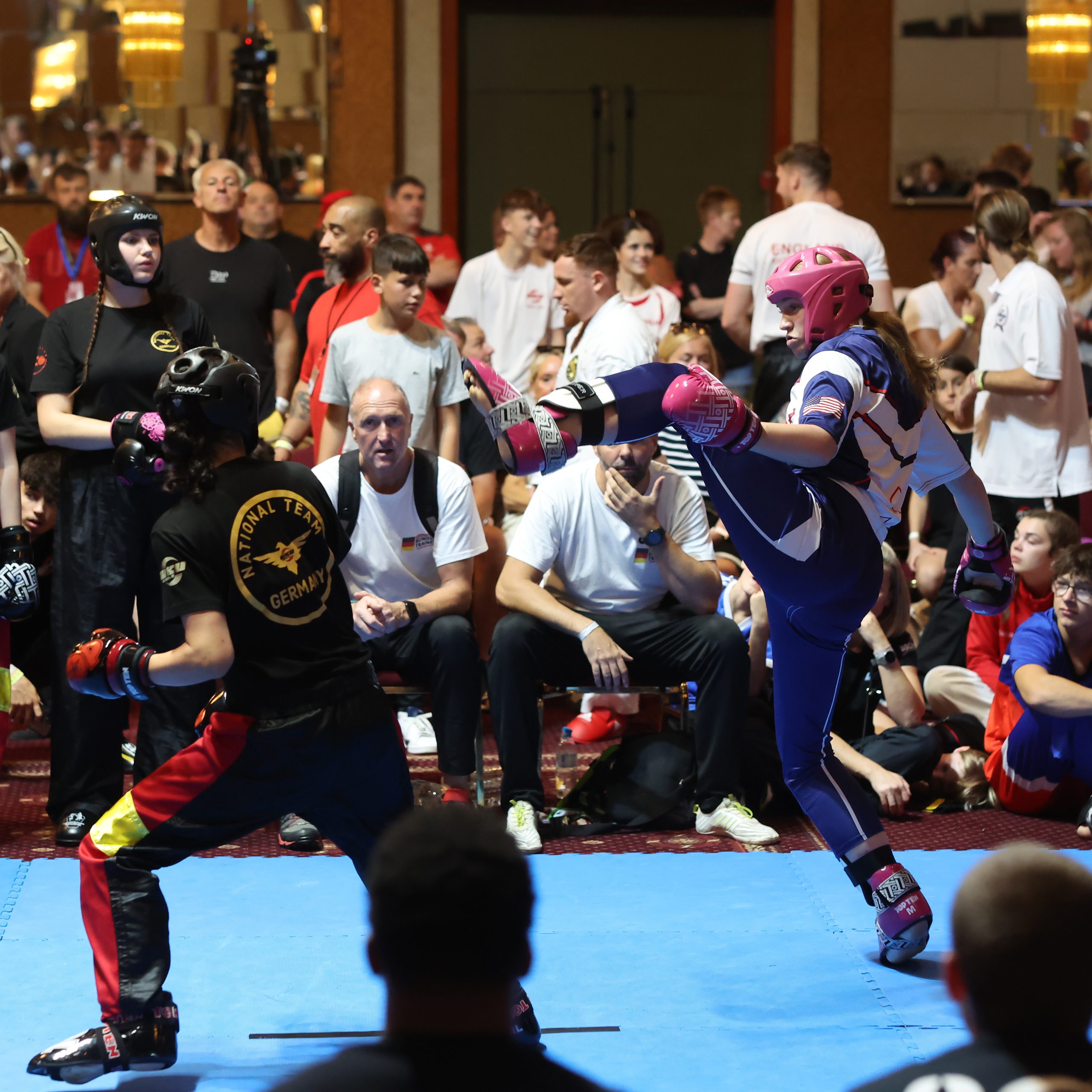
What is Pointfighting? Pointfighting is a stop-and-go discipline of kickboxing. When an athlete lands a clean, controlled technique, the referee calls “stop”, the officials signal the point, and the fight continues. It is the discipline of speed, timing and precision.
Pointfighting is also known under “Point Fighting”, “Point Sparring”, “Semi Contact” and “Sport Karate”.
Under WKUWORLD rules, athletes use:
- Punches (jab, cross/reverse punch, backfist, ridge hand)
- Kicks (front, side, roundhouse, hook, crescent, axe and spinning back kicks, including jumping and spinning versions)
- Foot sweeps and spinning sweeps
- Distance control, feints and explosive entries
In this guide you will learn how Pointfighting works, how it is scored and how it compares to Light Contact and Kick-Light.
Where Pointfighting Comes From
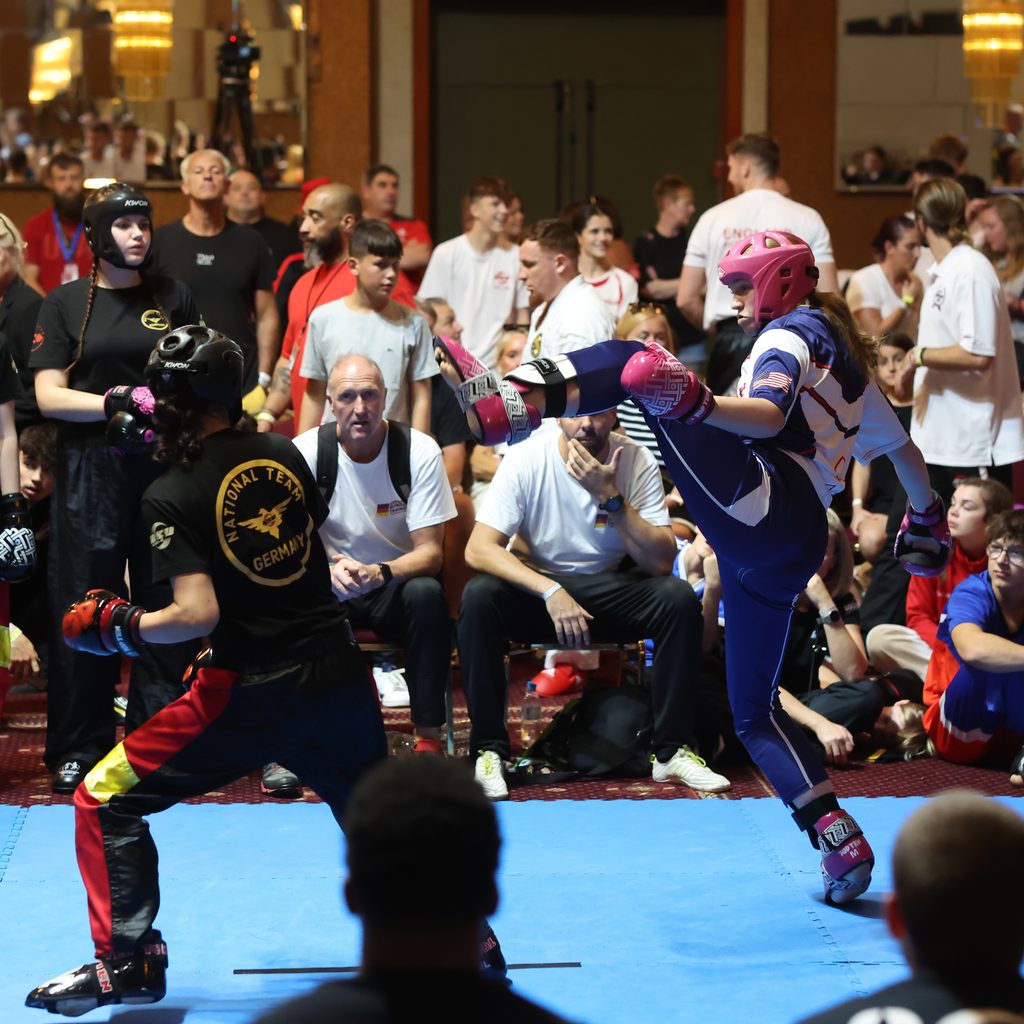
Pointfighting grew out of the karate tournament scene of the 1960s and 1970s, when competitors began wearing protective equipment and scoring with controlled contact. It became one of the first standardised kickboxing formats and is still a core discipline at international championships today. Its closeness to karate kumite explains why many athletes move easily between the two.
How Pointfighting Works
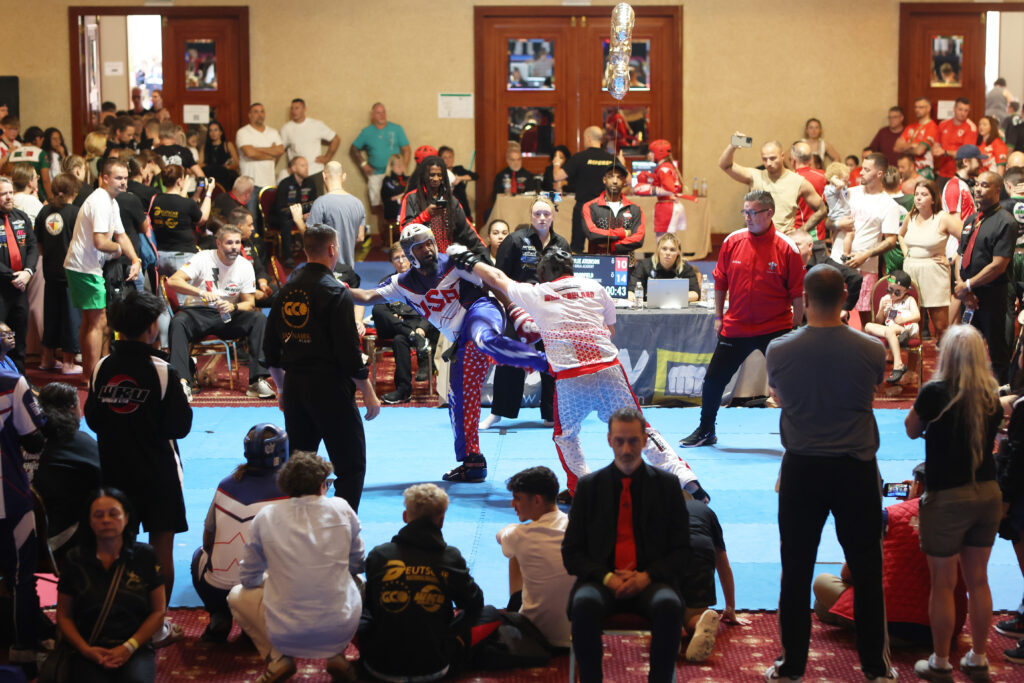
Every bout has three referees: a centre referee and two corner referees who move around the mat in an L-shape to get the best view. The centre referee starts the bout after the athletes touch gloves.
When any referee sees a point, the centre referee calls “stop” and all three referees signal at once. Under WKUWORLD rules, the clock keeps running while points are awarded. It only stops for warnings, equipment problems or injuries.
- Eliminations: 1 round of 2 minutes
- Finals: 2 rounds of 2 minutes, with a 1-minute break
- Tie: an extra 1-minute round without a break. If it is still tied, the first athlete to score wins
- 10-point rule: in the eliminations, a 10-point lead ends the bout (for example 0:10 or 2:12). This rule does not apply in finals
Scoring in Pointfighting
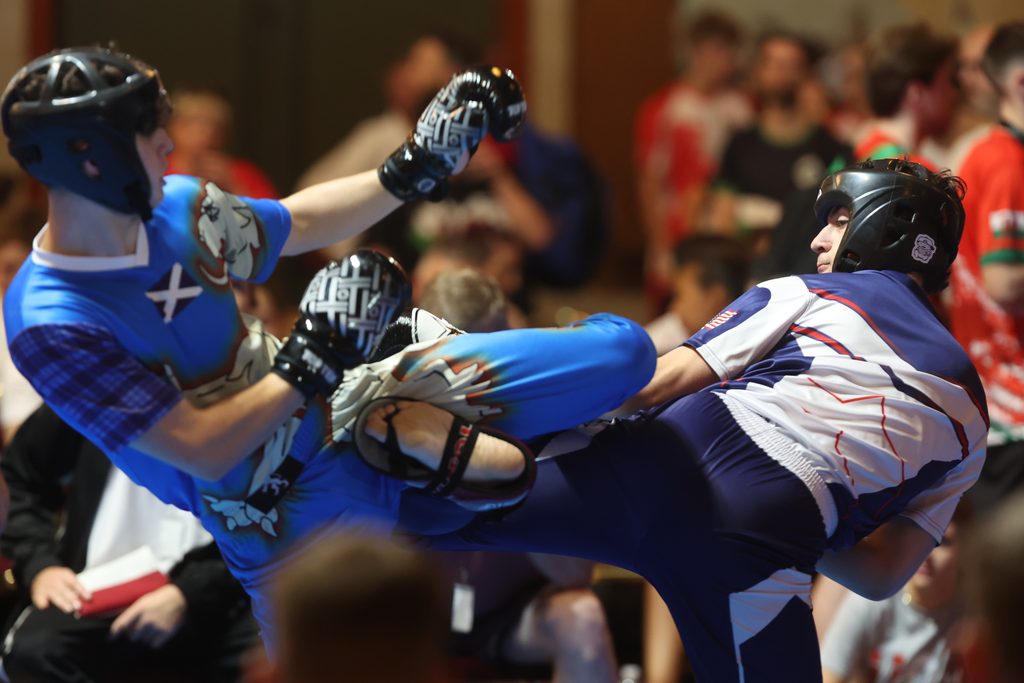
Points are awarded for clean techniques to the legal target areas: the entire head and face (including the face guard) and the front and sides of the body above the waist.
- Hand technique: 1 point
- Kick to the body: 1 point
- Kick to the head: 2 points
- Jumping kick to the body: 2 points
- Jumping kick to the head: 3 points
- Foot sweep: 1 point (the opponent counts as swept when their balance is broken and at least three body parts touch the mat)
How the referees decide:
- A point needs a majority: at least two of the three referees must show it
- If the majority agrees on the athlete but not on the value, the lower score is given
- If both athletes score at the same moment, both receive their points
- A warning overrules a point on the same call
- An athlete can still score on an opponent who has stepped out of bounds, as long as the technique lands before “stop”
- An athlete who falls can be scored on with a punch to a legal area within three seconds
The current official WKUWORLD Point Fighting Rules always apply.
Scoring Differs Between Organisations
Pointfighting is practised under many federations, and each one has its own scoring. If you compete in more than one organisation, these differences matter. A head kick worth 2 points with us can be worth 3 somewhere else.
| Technique | WKUWORLD | ISKA | WKO | WKL |
|---|---|---|---|---|
| Hand technique | 1 | 1 | 1 | 1 |
| Kick to the body | 1 | 1 | 2 | 2 |
| Kick to the head | 2 | 2 | 3 | 3 |
| Jumping kick to the body | 2 | 2 | 3 | 3 |
| Jumping kick to the head | 3 | 3 | 5 | 5 |
| Foot sweep | 1 | 1 | 2 with strike within 3 s | 2 with strike within 2 s |
Values taken from each organisation’s published point fighting rules, checked November 2026.
Round lengths differ too: WKUWORLD uses 2-minute rounds, while other organisations use rounds of 1 to 1.5 minutes. Karate athletes should also know that WKF kumite uses its own system (Yuko, Waza-ari, Ippon) with different target and contact rules.
Important: Rules change. Always read the current official rulebook of the organisation you are competing in before every tournament, including scoring, equipment and age categories. For WKUWORLD events, the current official WKUWORLD Point Fighting Rules always apply.
Allowed and Forbidden Techniques
What makes a point: a technique delivered dynamically, with control and recoil, with accuracy, speed and balance, and with power appropriate to the age and weight category. Only light to moderate contact is allowed. Only the front of the fist and the instep, heel, sole or ball of the foot score.
Not allowed: hooks and uppercuts, palm hand, knife hand, spinning backfist, elbows, knees, low kicks, strikes with the shin, sweeps above the calf, punches below the waist or to the back, throws, pushing, clinching, headbutts and excessive contact.
Warnings: after one verbal caution, each further violation costs a warning point. A fourth warning means disqualification. For serious fouls, the referee can give an official warning straight away.
Uniform and Equipment
Pointfighting at WKUWORLD keeps its martial arts roots visible:
- A clean top with sleeves covering at least half the upper arm
- Long pants to the feet, without zips, pockets or buttons
- A visible waistline (belt or contrasting colours); traditional uniforms are welcome
- No jewellery or piercings; long hair tied back; nails trimmed
- Full protective equipment, checked from head to toe before every bout. Breast and groin protection are confirmed verbally
Check the event announcement for the specific protective equipment required in your age group.
Team Pointfighting
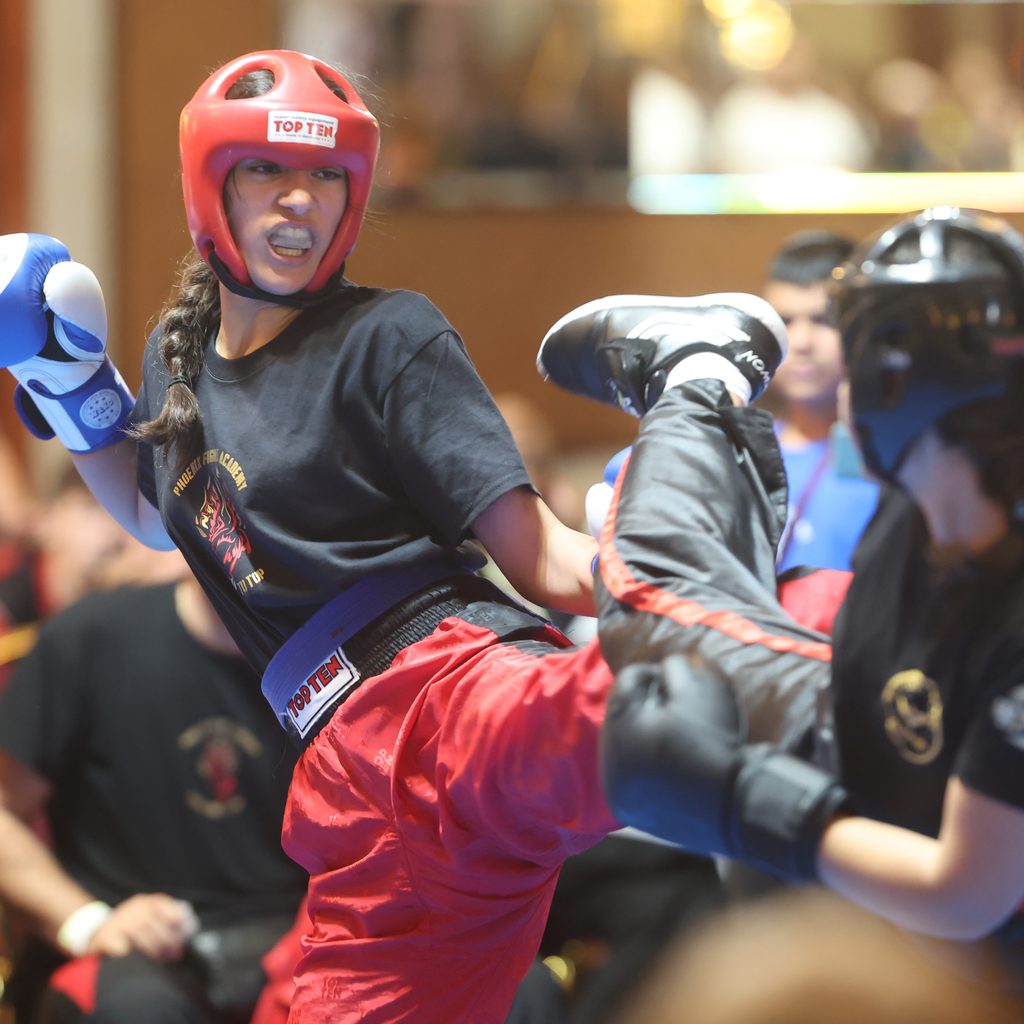
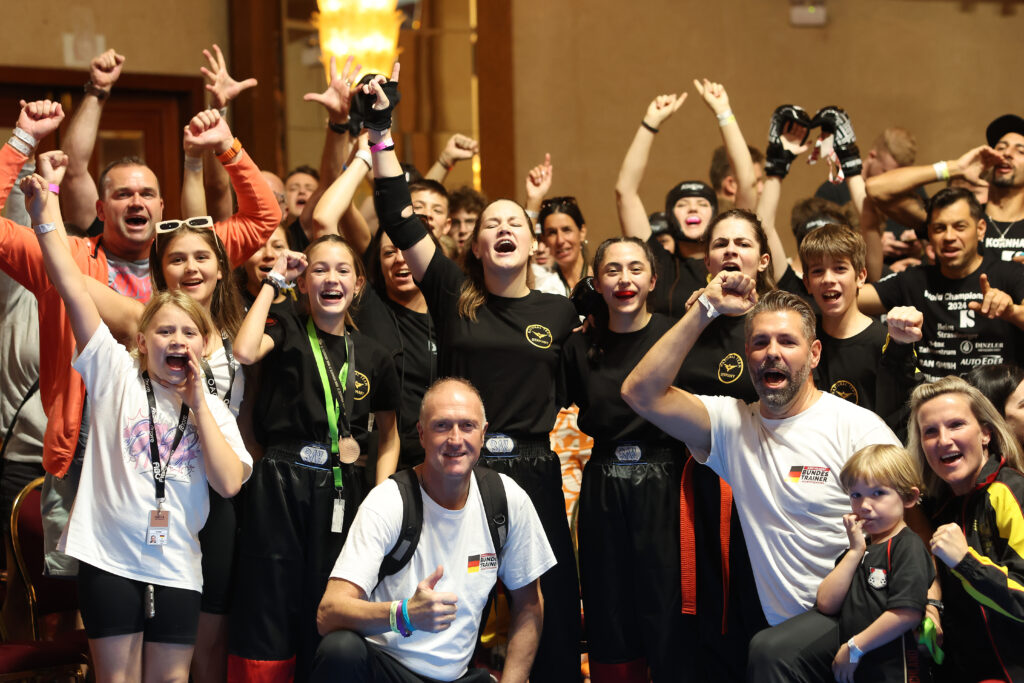
Team competition is one of the highlights of every championship. Women’s teams and kids’ and teens’ teams have three athletes, men’s junior and adult teams five plus one substitute. Each team member fights one 2-minute bout, and the team with the most total points wins. A tied team match goes to a 1-minute overtime and then a golden point.
Who Pointfighting Is For
Children and Young Athletes
Short exchanges, clear scoring and strong safety rules make Pointfighting an excellent first competition discipline, with categories from age 8. We observe that many of our long-term competitors started their tournament careers in Pointfighting.
Insight: Children thrive in Pointfighting when they are coached by trainers who have completed hands-on, kids-specific training. Kids should never be left with inexperienced trainers. A coach who can run a strong children’s class generally adapts easily to adult sessions.
Karate and Taekwondo Athletes
Athletes from traditional martial arts find familiar techniques, uniforms and timing in Pointfighting. It is a natural bridge into kickboxing competition.
Adult and Masters Competitors
Pointfighting offers categories up to seniors (55+), plus team competitions, and a clear pathway up to the WKUWORLD World Championships.
Pros
- Lowest contact load of the three controlled-contact disciplines
- Highly tactical and fast
- Ideal entry point for beginners and young athletes
Cons
- Shorter exchanges train less continuous stamina
- Requires patience to master timing and distance
Core Benefits of Pointfighting Training
1. Speed and Reaction Time
Pointfighting trains explosive starts and lightning-fast reactions.
2. Concentration and Tactical Thinking
Every exchange is a decision. Athletes learn to read their opponent, set traps and strike at the right moment. This is Concentration from the WKUWORLD 8 Stars in action.
3. Control and Discipline
A point only counts when the technique is clean and controlled. Precision, not power, wins.
Action Tip: Practise a reaction drill with a partner: your partner raises a pad without warning, you respond with one clean technique. 3 rounds of 1 minute. Reset after each strike.
From Points to Pros
Some people still ask whether Pointfighting is “real” fighting. The best answer comes from the athletes who started on the point mat and went on to become champions in full-contact kickboxing and MMA. The speed, distance control and timing that Pointfighting rewards turned out to be powerful weapons in the ring and the cage.
Michael “Venom” Page
Page started martial arts at the age of three and won his first world title at the 1998 ISKA US Open, aged 12. He went on to collect ten world titles in point fighting and was British champion more than 25 times (source) before becoming one of the most watched strikers in Bellator and the UFC. In an interview with VICE, he explained what point fighting gave him:
“It makes you move that much more, it means you have to figure out how to hit someone from further away.”
Michael Page, VICE, 2016
His father’s advice sums up the whole discipline: “Get in, hit. Get out, without being hit.”
Raymond Daniels
Daniels was an eight-time NBL World Champion and a multiple NASKA world champion, and won Pointfighting world gold in 2015. He then became Bellator Kickboxing Welterweight Champion and fought twice for the GLORY welterweight title (source). Page and Daniels met three times in the Irish Open finals, two of the best point fighters of their generation (VICE).
Stephen “Wonderboy” Thompson
Thompson went undefeated as an amateur and professional kickboxer before fighting for the UFC welterweight title twice. His karate-based style is built on the same principles as Pointfighting:
“I love the point game and being able to hit you without getting hit back.”
Stephen Thompson, via IMMAF, 2016
Bill “Superfoot” Wallace
The original crossover story. Wallace made his name on the point karate tournament scene of the late 1960s and early 1970s, was named Tournament Karate Fighter of the Year in 1973, then switched to full contact and became PKA World Middleweight Champion. He retired undefeated at 23–0 (source). His left hook kick is still studied by point fighters today.
Journalist and fight analyst Jack Slack put it simply: point fighting “does serve as an incredibly valuable training method” (VICE).
Watch Pointfighting in Action
📸 Relive the World Championship 2024 in print
Star photographer Tom Kohler captured the most thrilling fights and emotional highlights of the WKUWORLD World Championship 2024 in Rhodes in a photo book of about 100 pages. Each copy can be personalised: the cover and four inner pages are designed with your own photos, professional or taken on your phone. To order your copy, contact Tom Kohler at mail@tomkohler.de.

How to Start Pointfighting Safely
For Competitive Athletes
- Train at a WKUWORLD member school
- Gain at least 8–12 weeks of controlled partner training before your first tournament
- Study the official WKUWORLD Point Fighting Rules
- Register via the official event pages
For Instructors and School Owners
- Teach control and target accuracy first
- Use in-house mock tournaments with three referees to prepare athletes for the stop-and-go rhythm
- Combine Pointfighting with Light Contact for well-rounded athletes
School registration: office@wkuworld.com
Frequently Asked Questions (FAQ)
1. Is Pointfighting safe for children?
Yes. With full equipment, qualified coaches and experienced referees, it is one of the safest competitive combat sports.
2. Why are hooks and uppercuts not allowed?
WKUWORLD Pointfighting focuses on clean, direct techniques that the referees can see and judge clearly in a stop-and-go format. Hooks and uppercuts belong to Light Contact and Kick-Light.
3. What is the difference between Pointfighting and Light Contact?
Pointfighting is stopped after every score and points need a referee majority. Light Contact is continuous and judges count techniques throughout the round.
4. Is Pointfighting the same as karate?
They share many techniques and a common history, but kickboxing Pointfighting uses its own rules, scoring and equipment.
5. Can I compete in Pointfighting and Light Contact?
Yes, and many athletes do. See Light Contact, Pointfighting and Kick-Light compared.
6. Is Pointfighting real fighting?
Yes. You face a live, resisting opponent who is trying to score on you, and you have to make decisions in fractions of a second. The goal is different from full contact: Pointfighting rewards the first clean, controlled hit rather than damage. Fighters like Michael “Venom” Page, Raymond Daniels and Bill Wallace used exactly these skills to become champions in full-contact kickboxing and MMA (see From Points to Pros).
7. How hard is Pointfighting?
It is easy to start and hard to master. Beginners can compete safely after a few months of controlled partner training, because contact is light to moderate and the bouts are short. The hard part is the speed: winning at international level takes years of work on timing, distance and explosive entries. Physically, the short, explosive exchanges are very demanding, especially across several bouts on one tournament day.
8. Side kicks vs. front kicks in Pointfighting: which is better?
Both score the same under WKUWORLD rules (1 point to the body, 2 to the head), and both belong in every point fighter’s toolbox.
- Side kick: the longest-reaching kick, hard to get past, and ideal for stopping an opponent’s blitz or scoring from distance. The bladed stance used in Pointfighting makes it fast from the lead leg.
- Front kick: the most direct line to the target, quick to throw and easy to disguise, and great for jamming an opponent who is about to attack or as a set-up for hands.
Remember that a kick has to be a clean strike with the ball, sole, heel or instep of the foot. A pushing kick does not score, as pushing is not allowed.
9. Are there Pointfighting seminars?
Yes, and many established point fighters offer seminars. Look out for sessions with current top athletes such as Bailey Murphy and Luca Nonnemacher, or with legends like Bill “Superfoot” Wallace, who has taught seminars around the world. Seminars are a great way to learn new combinations and tactics straight from champions. Ask your school or contact us to find out about upcoming dates.
Conclusion
Pointfighting is the art of the perfect moment. It rewards speed, timing and control, and it offers a safe, structured entry into competitive kickboxing for every age.
Related Articles
- What Is Kickboxing? Rules, Benefits & Values Explained
- What Is Light Contact?
- What Is Kick-Light?
- Light Contact vs Pointfighting vs Kick-Light: What’s the Difference?
Looking for a great Pointfighting gym near you? Contact us and we will recommend a WKUWORLD member school where you can start training.
Discover upcoming WKUWORLD events at wkuworld.com/calendar and begin your journey today.
All photos: Thomas Kohler
See it live — the calendar is full.